
News
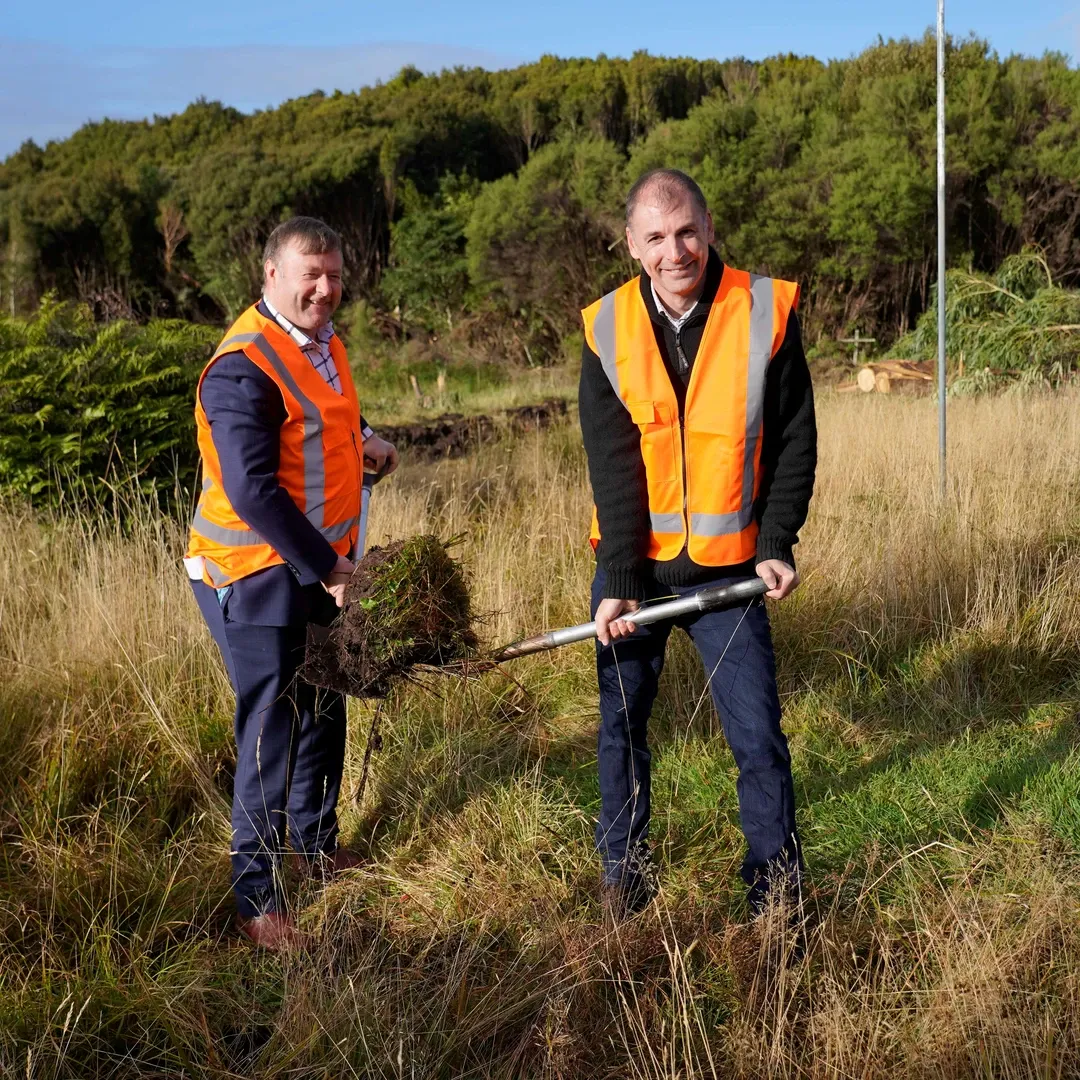
Construction of Stewart Island Rakiura’s long-awaited renewable energy project officially began today, with community leaders, government representatives, contractors, and residents gathering to mark the occasion at the future solar farm site on Airport Road.
Associate Minister of Regional Development Mark Patterson and Southland District Council Mayor Rob Scott turned the first sod at the two-hectare site, which will eventually hold about 3,000 solar panels. Around 40 people attended the ceremony before a larger community gathering later at the Pavilion.
Mayor Scott placed a small piece of turf into a jar during the ceremony, promising to return it once the project was complete.
“This project isn’t about fixing something that’s broken,” he told the audience. “It’s about building on what’s already here.
“It’s not my project, it’s not the minister’s project, it’s your project.”
Minister Patterson described the launch as “a really significant day for this community”.
“The majesty of living in this extraordinary place does come with a cost,” he said, adding that reliance on diesel generators was not the future the government envisioned for Stewart Island Rakiura.
Regional Public Service Commissioner Steph Voight said the island’s close relationship with the environment made the project especially meaningful.
“Today we celebrate partnership, progress … and a future that doesn’t rely on diesel.”
The Rakiura Energy Solutions project has explored alternatives to diesel-generated electricity since 2023. Stewart Island currently relies on diesel generators to supply electricity to 494 permanent connections, with consumers paying about 89 cents per kilowatt hour, around 240% higher than mainland electricity prices.
The first stage includes a two-megawatt solar farm, a four-megawatt battery system, and network upgrades. Once operational, the project aims to reduce diesel use by up to 75%, improving energy resilience while lowering costs for residents.
Electricity generated from the solar panels will feed directly into the network and batteries, with diesel generators only used during periods of higher demand. The battery system will store at least six hours of the island’s average energy needs.
Infratec, the company building the project, expects commissioning to take place in January 2027. General manager development and delivery Chris Service said the company was excited to bring its experience building solar and battery micro-grids in New Zealand and Tonga to Stewart Island.
“It’s a pretty exciting project for us … we’re really keen to take you on the journey with us.”
Invercargill MP Penny Simmonds welcomed the project’s progress, describing it as “a tremendous step forward for local people”.
“This really is a game changer for Stewart Island,” she said.
The Government announced a suspensory loan of up to $15.35 million from the Regional Infrastructure Fund in June 2025 to support the project.