
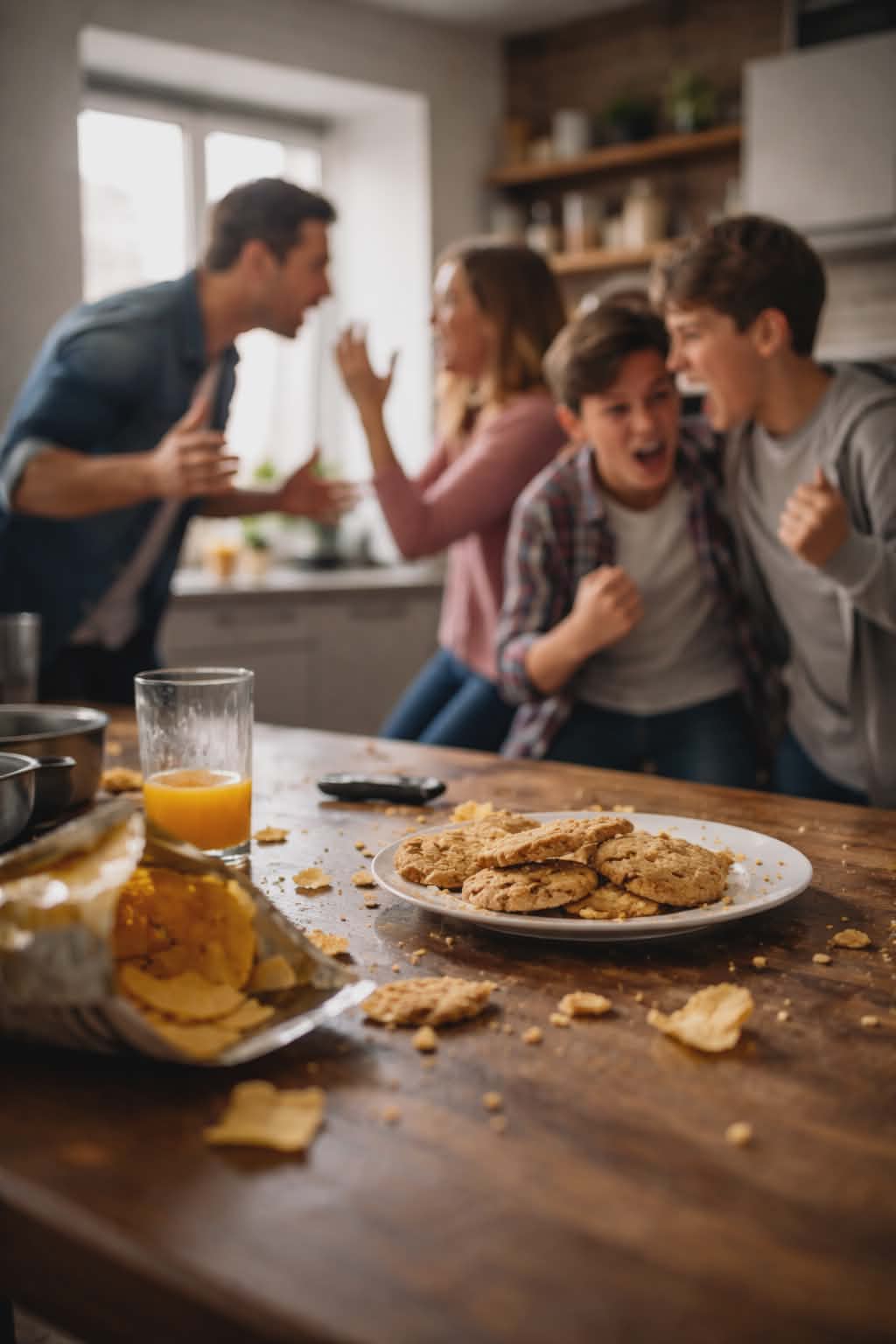
From biscuits to the battlezone: what childhood beliefs teach us about conflict.
Conflict’s a funny old thing, isn’t it?
Whether it’s the small, everyday frustrations—laundry left on the floor, a teaspoon put back the wrong way in the drawer—or something deeper, like a strained relationship, a workplace disagreement, or even the tensions we see playing out on a global stage.
They can feel worlds apart.
And yet, they all follow a similar pattern:
Someone says something.
Does something.
Or doesn’t do something.
And suddenly, someone feels upset, angry, or wronged.
We tend to focus on the details—who said what, who did what, and when, who’s right and who’s wrong.
But interestingly, the more a story is told and retold, the more tangled in the details we become.
And often, it’s those very details that are the least important part of what’s actually going on.
Let me tell you why.
I was reminded of this recently when my sons’ friend was pulled off his bike, kicked and punched on the ground by two other boys at a local BMX track.
It was the first time something like this had touched our family in 15 years.
We’ve been very lucky so far, but I’m sure there will be more to come.
As the kids came home and told their versions of what had happened, each story carried a slightly different angle—different emphases, different interpretations.
And as the story was retold over the following days, something interesting happened:
The details grew.
The certainty grew.
The emotion grew.
But clarity didn’t—and resolution became more and more distant.
Instead, everyone became more invested in their version of events.
And that’s when it really struck me—this is what we do.
Not just as children, but as adults too.
Not just in our homes, but everywhere.
With five boys at home, there is a lot of fighting and arguing—usually over food:
Who gets the biggest piece, the most?
The best bit?
Who had it first?
Who helped more?
Who deserves it?
On the surface, it's about the food.
But it’s never really about the food.
Just like—it’s never just about Iran’s nuclear program.
One child pushes forward, usually an older, bossy sibling, to take control and gives themselves the largest share.
Another kicks up a fuss—perhaps the youngest—knowing that noise often gets results. They get what they want because everyone, adults and kids, just wants to “shut them up.”
One withdraws completely, deciding it’s easier to go without than to argue.
Another burns with rage at the unfairness of it all, sitting somewhere between the manipulation and the entitlement.
Same situation.
Completely different reactions.
Why?
Because each child is not responding to the biscuits—they’re responding to what the moment means to them.
And that meaning has been shaped over years, especially the first seven years of life.
As we grow, our childhood experiences form deep beliefs about ourselves and the world around us.
Beliefs like:
It’s not fair.
People in charge can’t be trusted.
There’s no point trying.
I don’t have any influence.
These beliefs sit beneath our conscious awareness, quietly shaping how we see things.
They shape our perceptions, which influence our thoughts, which drive our emotions, which ultimately determine how we react and the decisions we make.
So what looks like a disagreement about food… or money… or rules… or even global events… is rarely about the thing itself.
It’s about the lens we’re looking through.
And this doesn’t stop in childhood.
It follows us into adulthood, where the same patterns continue to play out:
Controlling behaviour
Manipulation
Giving up
Seeking justice
Peacekeeping
Whether it’s:
Around inheritance disputes
In custody battles
At work, when promotions are missed or decisions feel unfair
In friendships, relationships, or communities
Or even how we respond to the wider world
Two people can look at the same global conflict—or its ripple effects—and walk away with completely different reactions:
One feels anger and injustice.
Another feels distrust and scepticism.
Another feels anxious and overwhelmed.
Another switches off entirely.
Same event.
Different lenses.
Different meanings.
Different reactions.
So here’s the question worth asking:
What if the intensity of our reaction isn’t just about what’s happening… but about what we believe it means?
The next time something winds you up or deeply upsets you—whether it’s small and domestic or something far bigger—pause for a moment.
Ask yourself:
What am I believing this means?
What belief might be sitting underneath this reaction?
And then gently challenge it:
Is this belief absolutely true?
Is it always true?
Or could this be an old pattern playing out?
And perhaps most importantly you could ask:
Is this belief helping me right now… or is it creating more tension in my day-to-day life?
Because when a belief leaves us feeling angry, anxious, or powerless more often than not, it’s worth questioning whether it’s really serving us—and instead being curious about:
What am I needing right now that I’m not getting?
Am I needing fairness?
To feel heard?
To be acknowledged?
To feel safe?
To feel in control?
To trust what I’m being told?
We may not be able to control everything happening around us—at home, at work, or in the world.
But when we begin to understand the lens we’re really looking through, we stop reacting to everything as if it is happening to us.
We move from reacting automatically, unconsciously… to responding with awareness.
From feeling at the mercy of every external situation—whether it’s the kids screaming and demanding from us, or sky-rocketing prices of fuel leaving us wondering how we’ll manage—to recognising that we have more influence than we think.
And that we actually have choices available to us.
Because in the end, whether it’s a packet of biscuits to argue over or conflict on the world stage—it’s rarely just about the thing itself.
It’s about the meaning we give it.
And that is something we can begin to change.
And that means a lot less unnecessary conflict and tension in our lives.
Now, who wouldn’t want that?
Katie Oliver.
Founder of True in Nature Bush School
Parent, Family and Relationship Mentor.