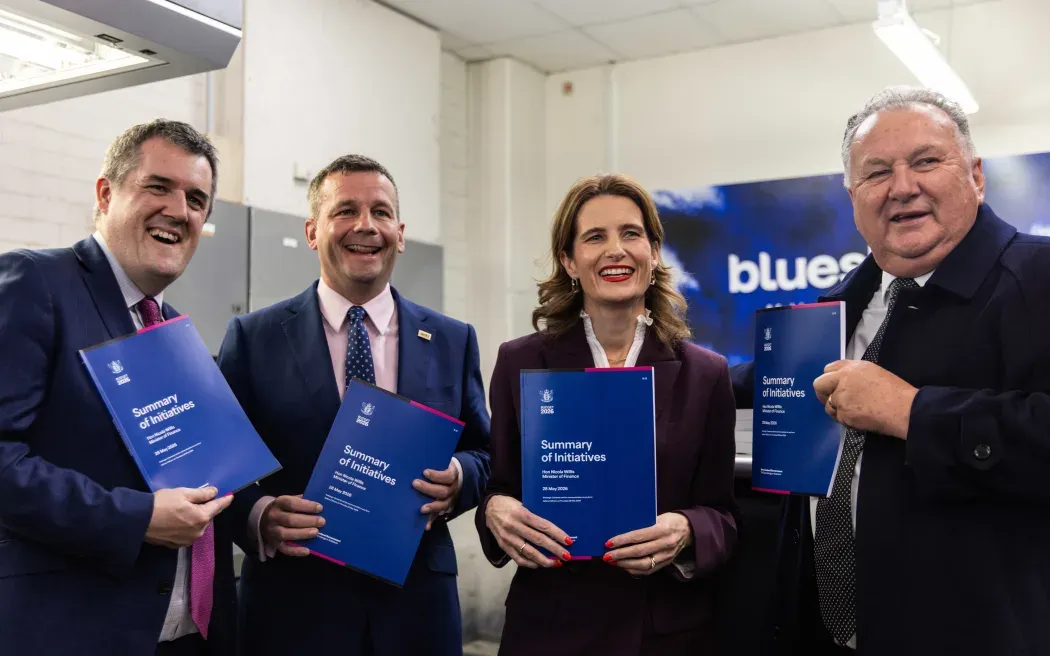
New Zealand will return to budget surplus a year earlier than expected, with Finance Minister Nicola Willis delivering a disciplined Budget 2026 focused on getting the books back in order.
Treasury now forecasts a $2.6 billion surplus in 2028-29 under the government's preferred measure, compared to a $900 million deficit predicted in December. If achieved, it would be the first government surplus in a decade.
Willis attributed the improvement to disciplined economic management, with $3.8 billion of new spending offset by $1.7 billion in savings. The government will also reduce its borrowing programme by $6 billion over four years.
Health emerged as the biggest winner, receiving $5.8 billion in new funding. This includes $5.5 billion for frontline services over four years, $34 million for three-day postnatal stays, and $33 million to extend bowel screening eligibility from 58 to 56 years of age.
Another $680 million will fund health infrastructure projects, including a 158-bed ward at Whangarei Hospital and work at Tauranga, Hawke's Bay and Palmerston North hospitals. A further $930 million goes toward clinical equipment, technology upgrades and facility improvements nationwide.
Transport Minister Chris Bishop announced $1.77 billion to extend the four-lane Waikato Expressway from Cambridge to Piarere Road. The government is also investing $1.075 billion in KiwiRail's network and $107 million in city rail upgrades.
Most government ministries face budget cuts totalling 12 percent over three years, starting with 2 percent this year followed by two 5 percent cuts. Health, education, law and order, defence and Oranga Tamariki are exempt.
Education funding includes 2 percent increases to school operations grants and 1.5 percent rises to early childhood subsidies. The budget allocates $240 million for new school curriculums and secondary qualifications, plus $69 million to double Trades Academy students to 20,000 by 2030.
Defence receives $2.3 billion in capital spending and $1.2 billion in operating funding for staffing, frigates, facilities and Pacific resilience measures.
The government introduced several new revenue measures. A prudential levy on banks, insurers and financial companies will raise $209 million over four years to cover Reserve Bank services. Willis said this represents less than 1 percent of the big four banks' total profits.
Revenue Minister Simon Watts announced major charity tax changes, increasing untaxed net income from $1000 to $10,000 annually while capping donation tax credits at $100,000 per year.
Councils will receive funding through a $400 million 'Incentives for Growth Fund' to encourage home building, with money allocated based on housing consents issued.
The government set aside $450 million as emergency funding for fuel-related issues, while $43 million will upgrade SuperGold cards to serve as official identification.
Fringe benefit tax rules for company vehicles will be simplified, removing detailed logbook requirements in favour of a 'close enough is good enough' approach to reduce business compliance costs.
Willis pushed back against election-year spending, calling it a back-to-basics budget focused on fiscal responsibility rather than vote-winning announcements. However, global uncertainties including the Iran conflict could affect future forecasts.
Share this article
The link has been copied!
Your link has expired. Please request a new one.
Your link has expired. Please request a new one.
Your link has expired. Please request a new one.
Great! You've successfully signed up.
Great! You've successfully signed up.
Welcome back! You've successfully signed in.
Success! You now have access to additional content.