
News
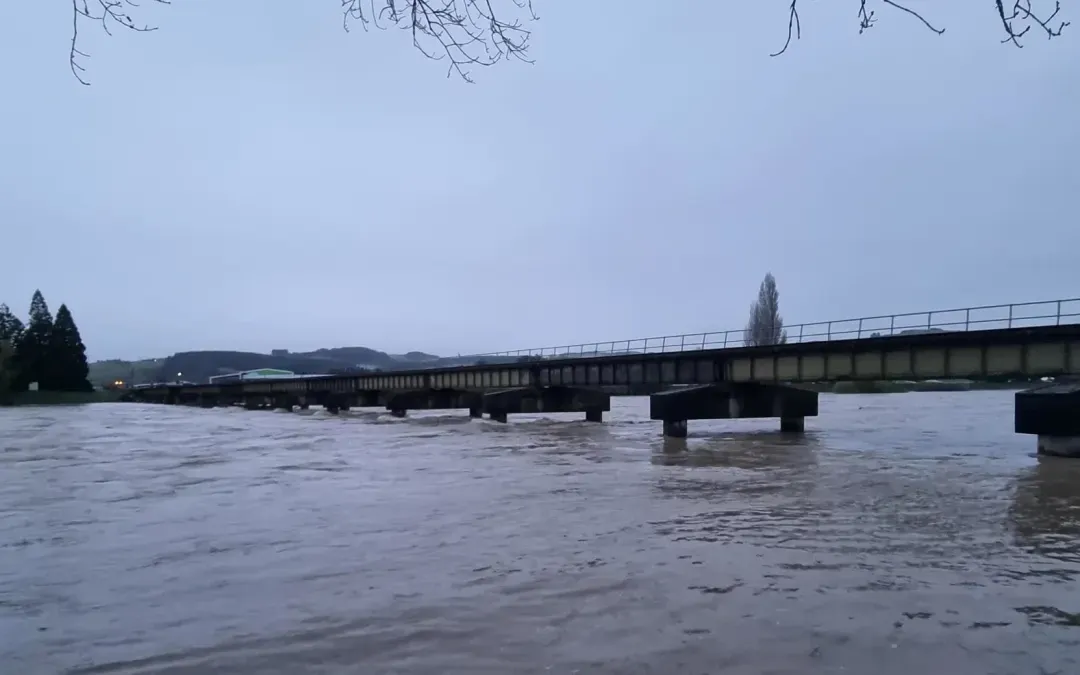
A petition with more than 3,200 signatures landed on the Gore District Council's table last week, and it signals how charged the debate over flood risk on the Mataura River has become.
The signatures were gathered by farming advocacy group Groundswell NZ, which is fighting requirements in the district's proposed plan that would force new builds in the flood zone to be constructed several metres higher than existing homes — enough to withstand a one-in-200-year flood event. The group is also an appellant in the district plan process and is awaiting mediation with council officials.
Groundswell co-founder Bryce McKenzie said the requirement was unworkable and was landing heavily on the wrong people. "There's things that we think could be looked at rather than put all the cost and burden onto the residents that live in that zone," McKenzie said.
He pointed to what he saw as unfinished business on the river itself — sediment and gravel clogging bridge piers, flood banks that could be raised and widened. "[The regional council's] just done some widening of the river at the bottom end of Gore, and they claim that's going to increase the flow by 13 percent. Flood banks could actually be widened and even made a bit higher as well," he said. "There's always been opposition to cleaning rivers out. But let's face it, if we don't start doing that, we're going to be in major trouble."
The Mataura River has flooded the surrounding townships — Gore, Mataura, Wyndham — repeatedly. Significant events in 1957, 1978 and 2020 are on the record. A heavy rainfall in September 2023 prompted evacuations and overwhelmed stormwater and wastewater systems across the area. Gore, a rural service town of more than 8,300 people, sits right on the 240-kilometre river.
Environment Southland has already done some of the physical work McKenzie is calling for — it recently dredged nearly 22,000 cubic metres of sediment from a section of the river south of Gore's main bridge, widening the channel to increase flow capacity. And a larger programme is now under way.
The Mataura River Flood Resilience Project has $10.8 million in government co-funding, matched with $7.2 million from Environment Southland. It is currently reviewing 14.5 kilometres of flood management assets — stop banks, much of which is owned by the Gore District Council — and will assess existing infrastructure to identify what needs improving.
Environment Southland general manager of integrated catchment management Lucy Hicks said the river's history made the need for ongoing investment clear. "The river has a long history of overflowing onto its floodplain," Hicks said. "As communities, businesses, farmland and infrastructure have developed alongside the river, the consequences of flooding have become more significant. Ongoing investment in maintenance, upgrades and targeted adaptation is needed to sustain agreed service levels, recognising that flood defences reduce effects but cannot guarantee protection in all events."
Hicks said the project will be delivered in stages. A list of possible works is expected by mid-next year. "[The project] will help identify potential future work and may support subsequent business cases and applications for Government co-funding. Any future projects would remain subject to further investigation, funding decisions and necessary approvals. This process will be commencing in the next three months."
A longer-term planning document — the Mataura Blueprint — will pull together technical data, community views and other evidence to guide future flood-risk decisions and investment. It is expected to be completed by mid-2028.
A separate $500,000 project is also funding new river-level and rainfall monitoring sites and cameras across the catchment to strengthen flood warning.
Gore District Mayor Ben Bell said the community conversation around what comes next cannot be avoided, whatever the district plan process produces. "We will have to have a conversation as a community around whether Southland spends a lot of money on flood mitigation, which in my personal opinion I think is a good thing. I think that you can mitigate the Mataura River," he said. "Or whether it is that managed retreat."
Bell said the scale of the catchment meant there was real scope for work further upstream. "We have a very large catchment, so there's lots of opportunity to do river mitigation further up," he said. "But it's really the responsibility of the regional council to get on with that and listen to the views of the community."
He noted the contrast with districts like Buller on the West Coast, where managed retreat is already being discussed more seriously because mitigation options are limited. On the Mataura, he said, there is still a genuine choice to be made.