
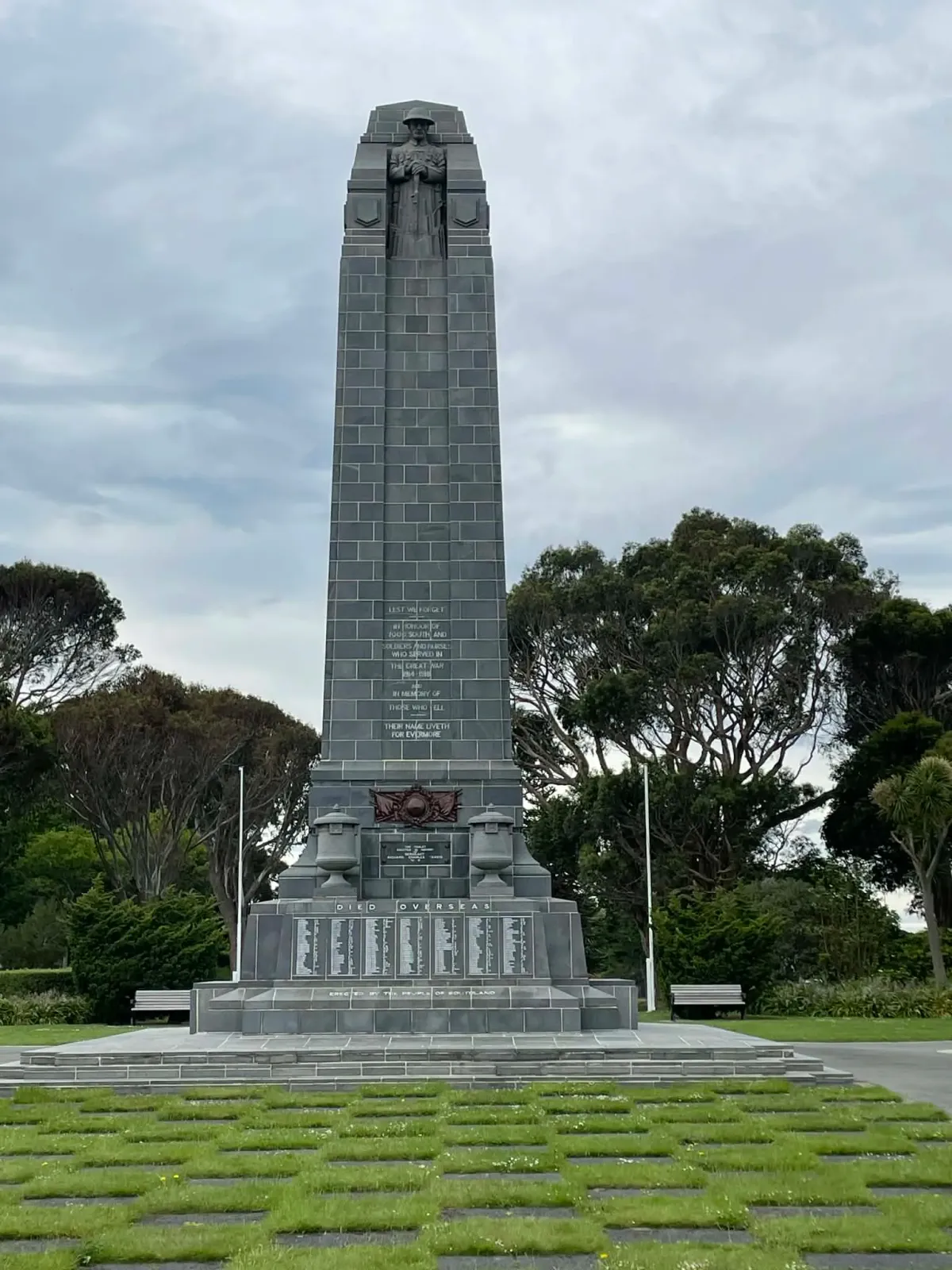
This week marks 100 years since the Southland Cenotaph in Invercargill was officially unveiled to honour local men and women who served and died in World War I.
Unveiled on 6 December 1925, the cenotaph was revealed to the public in a significant ceremony led by then-Governor General of New Zealand, Sir Charles Ferguson. A crowd of more than 6000 people gathered for the occasion, including around 1000 returned soldiers.
Invercargill Mayor Tom Campbell reflected on the centenary, saying the cenotaph still holds great meaning for the community. “The Southland cenotaph is an enduring reminder that we must continue to honour those who served, and ensure their stories are never forgotten,” he said. “A century later, the cenotaph does more than honour the legacy of those who lost their lives. It challenges us as a community to live in a way that reflects upon and respects the sacrifice made in the past, for our future.”
The idea for a memorial began shortly after the end of WWI, when the Fallen Soldiers Memorial Committee was formed in Invercargill to raise funds. The final design, created by Dunedin-based architectural firm Coombs and White, was heavily influenced by The Cenotaph on Whitehall in London. That memorial, by Sir Edwin Lutyens, was unveiled in 1920 to honour those lost from Britain and the Empire.
The Southland Cenotaph features a 10-foot-high soldier statue, sculpted by G. Cancare, and was carved entirely from Bluff granite. Alongside the names of Southland soldiers killed in action, it also includes Southland nurses who lost their lives during the war. Members of the public were invited to submit names and details of their loved ones to be included.
The original programme described the monument as being “Erected by the People of Southland in Grateful Remembrance of those who, at the call of Duty, left all that was dear unto them, faced danger, endured hardship, and finally laid down their lives for their Country in the Great War, 1914 – 1918.”
The unveiling featured performances of Nearer, my God, to Thee, the Last Post, and God Save the King. The Mayor of Invercargill at the time, Andrew Bain, also delivered an address.
Mayor Campbell said the turnout each year, particularly on ANZAC Day, proves that remembrance remains strong. “While the world has changed enormously since 1925, the horror at the human cost of war still resonates deeply. Looking at the cenotaph today, we are not just remembering names carved in granite – we are mourning those whose contribution to our community was cut tragically short.”
The word cenotaph is derived from the Greek words kenos and taphos, meaning ‘empty tomb’.