
Education
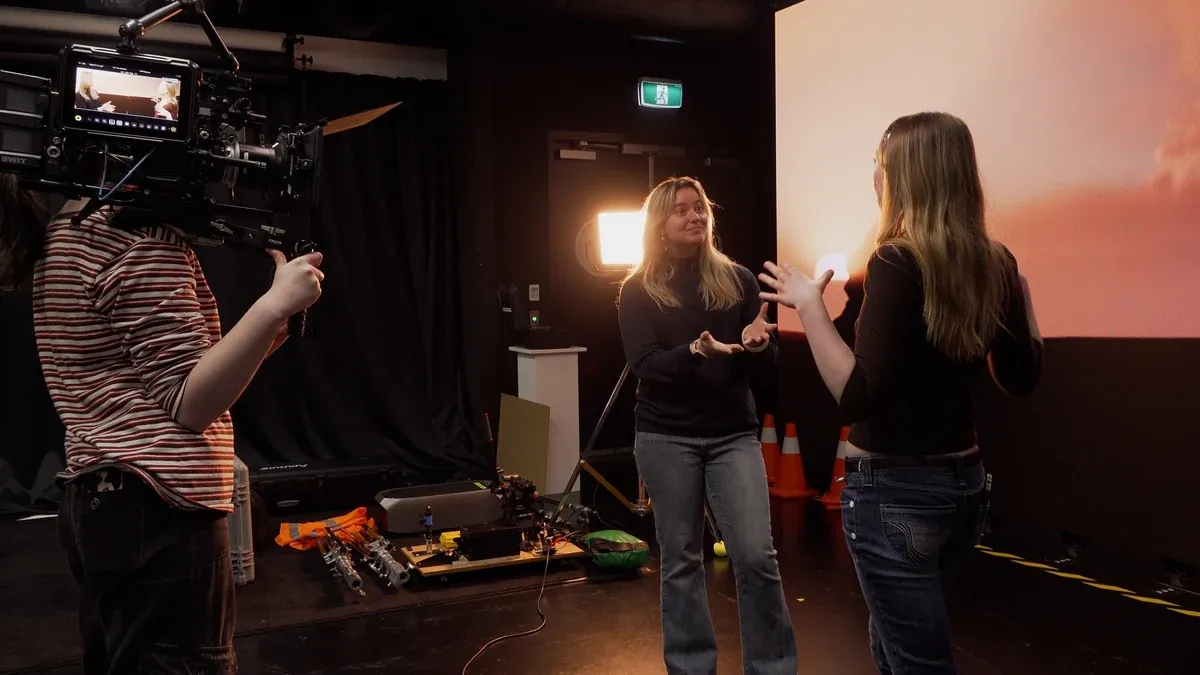
SIT Screen Arts students help bring Southland stories to life for new museum
Southern Institute of Technology (SIT) Bachelor of Screen Arts students had roles in the production of multimedia content for Invercargill’s highly anticipated Museum of Southland, gaining valuable professional experience in the process.
Seven students, including five current students and two recent graduates, spent seven days working alongside leading film and visual effects professionals on a major multimedia installation being produced by Wellington-based Gibson International.
The opportunity came about after SIT Bachelor of Screen Arts Programme Manager James Wilkinson offered the production team access to SIT’s screen production facilities, including its studio and virtual production volume, in exchange for students being involved in the project.
While details of the museum installation remain under wraps, visitors can expect an immersive multimedia experience exploring different periods of Southland’s history.
Working alongside experienced crew from Auckland, Wellington and Queenstown under Director Sam Tozer of LOT23 gave students hands-on experience of professional production and opportunities to build industry connections.
“A couple of the students have already had potential opportunities come their way, and the door is open for further work in Wellington. They’ve been encouraged to get in touch if they’re heading up there,” Mr Wilkinson said.
Gary Scott, Head of Content & Media – GIL, said his team was impressed by how well the students integrated into the professional crew.
“They were well trained, knew the equipment and production techniques. As well as being valuable crew members, their willingness to take on different roles, think outside the box a bit and offer solutions were really appreciated. They all had a great work ethic, and it worked out really well to have them integrated into the team."
Third-year Bachelor of Screen Arts student Ella Burton worked as Camera Assistant, gaining hands-on experience with professional camera equipment and techniques.
“With the camera assistant, most of the time I was slating, so using the clapper and just marking everything. But I also got hands-on with the cinematographer, and he would teach me how to use the cameras that we were using, because it’s not a camera that we have at SIT. I was doing some focus pulling with that as well.”
Ella was particularly interested in learning techniques used for green-screen filming, including the crew’s use of a raised floor.
“It wasn’t something that I thought of before, but with green screen you always worry about the feet because it’s going to look wonky when you cut them out. What they did is they had a raised floor, so they were standing on it and then everything else in the background was green.
“It was very precise about where the camera was and the angle of it. That was quite interesting to me.”
Seeing an experienced professional crew in action was another highlight.
“I think the experience as a whole was definitely amazing. Especially being on an actual set and seeing how professionals conduct themselves. I think that was definitely a high point.”
“Everyone was very professional and onto it and they knew what they were doing, but there was still room to have fun, which I enjoyed.”
Although initially nervous, Ella found her Screen Arts training had prepared her for the step up to a professional environment.
“I think I was a little nervous in the beginning, just because it’s new people and you don’t know how intense they might be. But once I got on set and once we started moving and everything, and I understood what we were doing more, just in the context of the story, I felt good and I felt like I was prepared.”
For the Gore-raised student, there was also a personal connection in helping tell stories from her own region. “I thought it was quite cool learning little bits of history. Some of it I didn’t know about, so it was nice learning things along the way.”
Most importantly, the experience confirmed her career direction. “I think it really solidified that this is what I want to do. I had a lot of fun being on that set and learning lots of stuff. I was like, I could do this for a living and I’d be happy.”
Fellow third-year student Savanna Conradie gained a very different perspective on professional production through her role as a Production Assistant (PA).
One of the first people on set each day, she helped look after arriving actors and supported the wider production team.
“I would be … making them comfortable and showing them where they needed to be; my role was looking after them, giving them water, seats, making sure that they had food, coffee. If the director or anybody needed anything, I would go grab it.”
Like Ella, Savanna found stepping onto a professional set daunting initially, but the welcoming crew quickly put her at ease.
“I think the first day was super overwhelming and scary, but then once I met everyone and talked to them, they were just so lovely, and they showed that they were here to do their job and encourage us to be involved.”
Her role involved long production days and taught her about the importance of working effectively with people. “I think the most valuable thing I learnt was how to work with new people and how to make everybody comfortable.”
Seeing Southland represented on screen gave the production particular meaning for Savanna. “I think it was just really, really special because it was also involving so many local actors and local people in the stories.”
The internship also broadened her thinking about how her Screen Arts skills could be applied after study. “Being on film shoots has opened my eyes to marketing positions and doing content and similar things because I really enjoyed the on-set environment.”
Beyond the student experience, the project demonstrated the potential for more professional screen productions to take place in Invercargill, using SIT’s facilities while supporting the wider Southland screen community.
“It supported not just SIT, but also the film community down here … all of that production would have stayed in Wellington, most likely, or Auckland,” Mr Wilkinson said.
He said the collaboration had also generated interest in bringing further projects to Southland. “The outcome exceeded the companies’ expectations, and they indicated they may bring other projects to the region next year.”