
Education
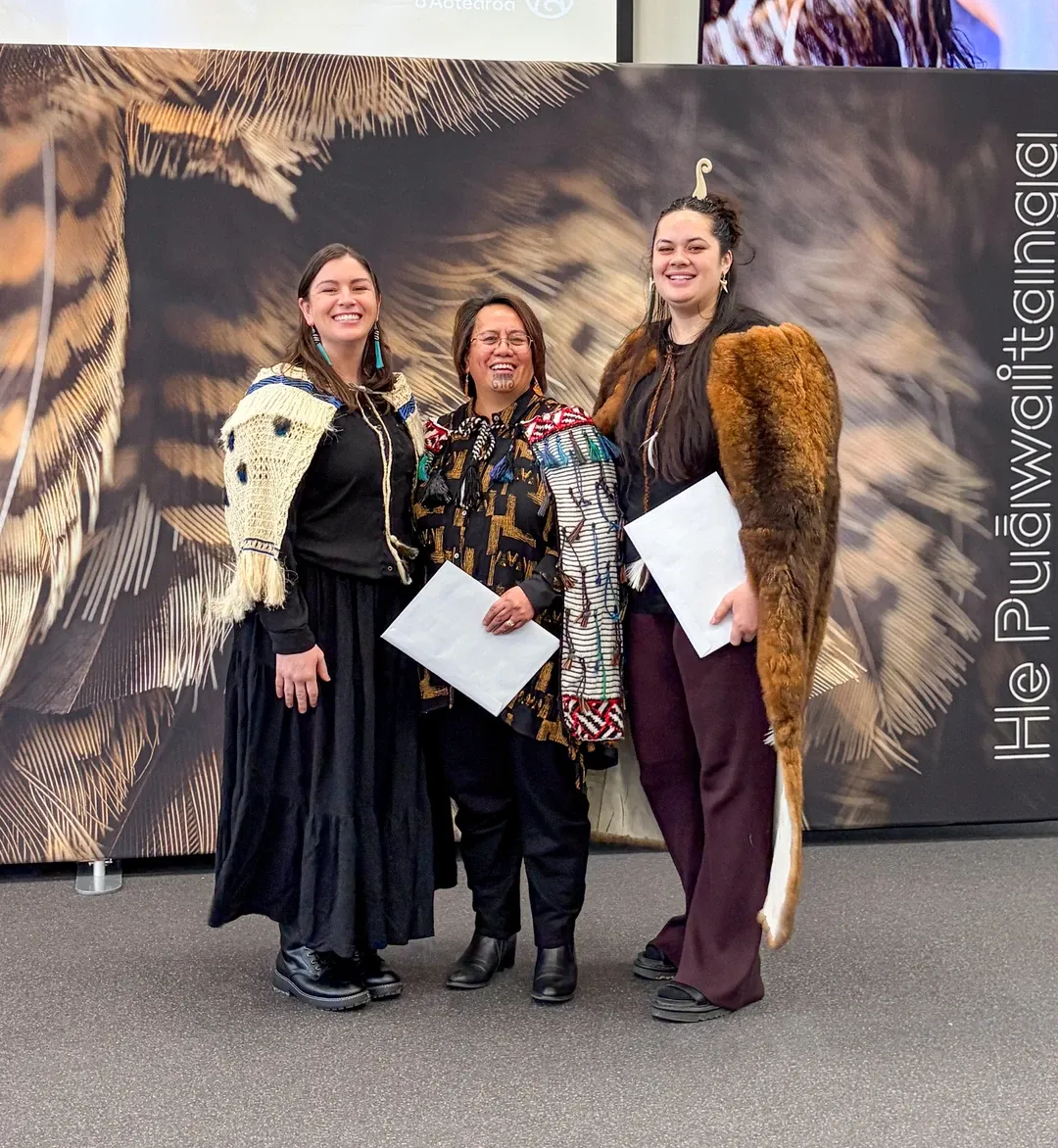
Athena Kent spent years feeling the pull to learn te reo Māori and doing nothing about it. Then she signed herself up, set herself a challenge to finish Level 1, and couldn't stop. She's now preparing to complete a New Zealand Diploma in Te Reo at Level 6.
Kent was one of two graduate speakers at the Te Wānanga o Aotearoa graduation held at SIT Hansen Hall on September 5, where students from te reo and weaving programmes marked the end of studies that, by their own accounts, changed more than their skill sets.
Addressing the room on behalf of the te reo graduates, Kent described the friendships formed through the programme as the backbone of getting through hard stretches. "I've made many friends along the way who I now consider to be whānau. We lean on each other in the hard times," she said.
She wasn't shy about what drove her to finally enrol. "There has always been a calling in me to go and study Māori, and every year that I didn't do it I felt so terrible. So, I signed up by myself and made a wero for myself — to complete level one."
The experience she describes is full-immersion in the broadest sense — noho marae, a dawn hīkoi at Waitati watching the sunrise from Māpoutahi Pā overlooking Karitane, kōrero Māori with friends, and hui and wānaka wherever she can find them. "What I have learnt is that this journey will never end. For me, my journey ahead looks like attending Māori kaupapa hui, wānaka, noho marae, meeting with friends to kōrero Māori, anything to keep me immersed in te ao Māori!"
Weaving graduate Gladys Henderson framed her class's programme as "Finding Our Ara" — finding one's path — and the story she told was as much about what harakeke does to the people handling it as what they do to it. "[When] our hands met harakeke something changed… We boiled it. We dyed it. We split it. We softened it. And sometimes, I suspect, it did much the same to us."
Henderson paid tribute to the late kaiako Rokahurihia Ngarimu-Cameron, whose influence on the class went well beyond technique. "Roka did so much more than teach us how to weave. She wove us together as whānau," Henderson said. She closed with the lesson she said sat at the heart of the programme: "He tangata. He tangata. He tangata. What is the most important thing? It is people."
Henderson was wearing a contemporary kākahu made by classmate Willie Solomon when she spoke. She was flanked at the ceremony by kaiako Rangiputa Wallace, who teaches weaving in Queenstown, and Te Raita Ngamoki, who teaches in Invercargill.
Professor Jacinta Ruru, a University of Otago law professor and member of Te Wānanga o Aotearoa's governing council, addressed graduates and their supporters at the ceremony. She pushed back on any reading of a qualification as the main point of the exercise.
"It is a beautiful expression because it reminds us that education is not simply about gaining a qualification. It is about growth. It is about discovering strengths, building confidence, strengthening identity, and preparing ourselves to contribute to our whānau, communities, and the wider world," she said.
She told graduates the lessons that would last longest weren't in any textbook. "Some of the most valuable lessons learned during study are not found in textbooks or assessments. They are found in perseverance, self-belief, collaboration, and personal growth. These lessons will continue to serve you long after today."
Professor Ruru also acknowledged everyone who helped graduates get there. "…Take time to acknowledge what you have achieved… Then step forward into your next chapter with confidence, knowing that you carry not only a qualification, but also the knowledge, values, and experiences that will help shape your future."
SIT chief executive Bharat Guha spoke at the graduation as part of the institute's ongoing partnership with Te Wānanga o Aotearoa. He told te reo graduates what their study meant beyond the classroom. "For those of you from Te Whare Reo, every time you speak te reo Māori, you are helping to keep alive a language that carries whakapapa, history, identity, humour, values and a unique way of seeing the world."
Guha urged graduates to keep going and keep sharing. "You have knowledge to share. You have a language to speak. You have traditions to practise. And you have taonga to pass on to those who will come after you." He closed with a direct call: "Kia kaha te kōrero Māori. Kia kaha te raranga. Kia kaha te ako. Keep speaking. Keep weaving. Keep learning. And, most importantly, keep sharing what you know with others."
The Invercargill ceremony was one of 45 graduations Te Wānanga o Aotearoa is holding across the country this year, celebrating 20,718 students in total.