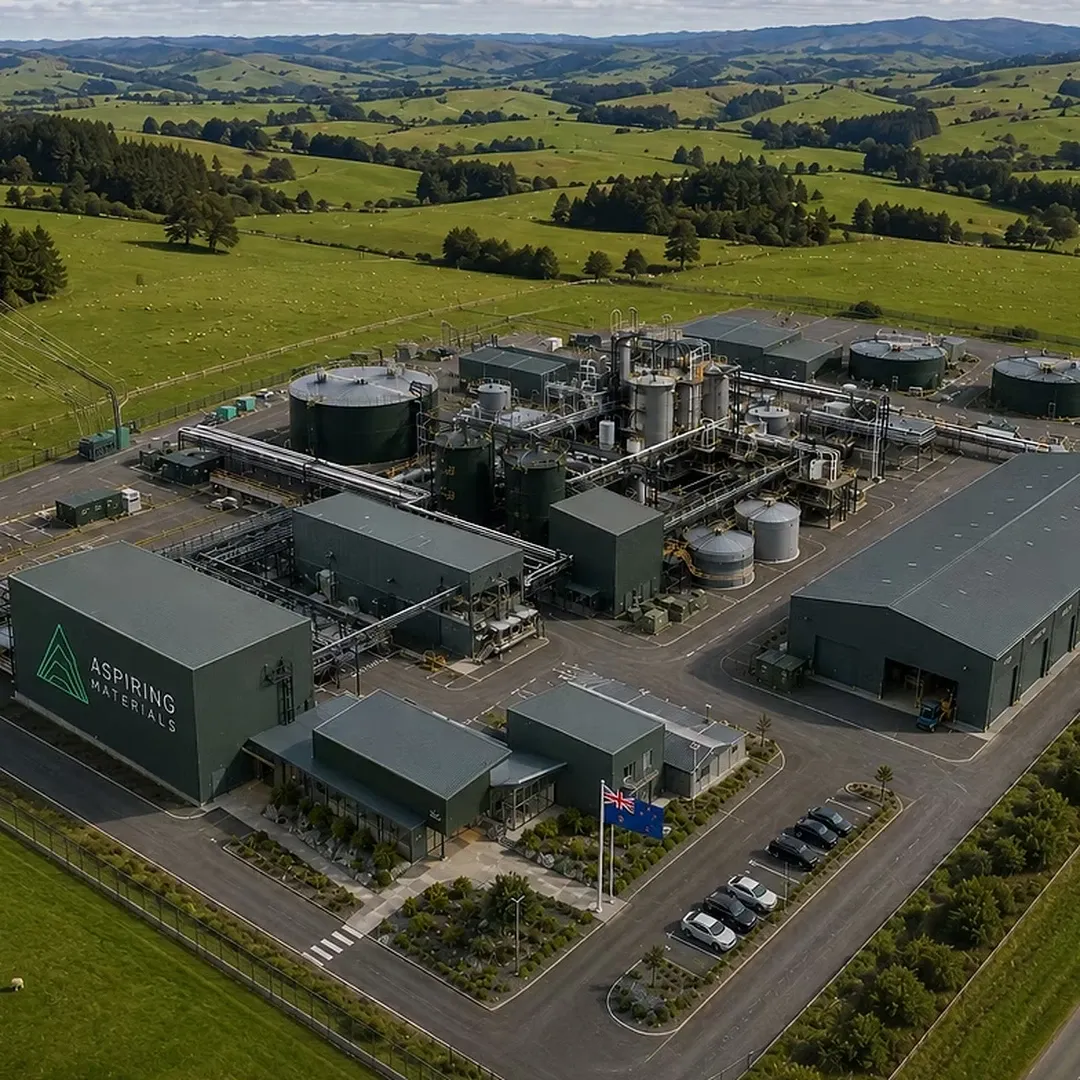
Southland is getting a critical minerals and green hydrogen plant, backed by $15 million in government funding.
Christchurch-based Aspiring Materials has secured the Regional Infrastructure Fund allocation to build a $31 million commercial facility in the region — its first at full commercial scale, following a successful pilot plant in Christchurch. The site location is expected to be confirmed in the coming months, with operations set to begin late 2028.
The plant will process 250,000 tonnes of olivine rock per year — quarry waste that would otherwise go nowhere useful. From it, the company extracts magnesium, silica, and nickel hydroxide, materials used across construction, primary industries, and energy sectors. Green hydrogen is a byproduct of the same process. No waste. Near-zero emissions.
At full capacity, the facility is expected to create up to 200 full-time roles — chemical and mechanical engineers, logistics workers, tradespeople — plus further jobs during construction.
Regional Development Minister Shane Jones announced the funding at a hydrogen sector event in Christchurch. The $15 million comes from $80 million ringfenced within the Regional Infrastructure Fund specifically for critical minerals projects and will be a mix of loan and equity, with the split still to be finalised.
"It is home-grown technology with the potential to produce green hydrogen while undertaking the business's core task of creating value from critical minerals and essential materials that are used daily across Kiwi industries," Jones said.
He pointed to heavy transport and high-temperature industrial processes as sectors where hydrogen makes more sense than electrification — an honest acknowledgement that batteries alone won't do everything.
Aspiring Materials developed what it calls the Aspiring Process, technology that grew out of research by its founding team at the University of Canterbury. The patented method uses electricity from renewable sources to split water, producing hydrogen, while simultaneously pulling valuable minerals from olivine rock.
Chief executive Mark Chadderton said Southland was always the target location. "Southland had long been identified as the ideal location for our first commercial plant for its proximity to existing quarry operations and key industrial customers. It's also home to some of New Zealand's largest industrial sites and has strong existing domestic transport links and port facilities. This is essential as we're already seeing strong demand for our materials both locally, throughout the country, and from overseas," Chadderton said.
Chadderton added that the plant's products would "strengthen domestic supply, boost New Zealand's competitiveness in the critical mineral sector, and support a new generation of advanced manufacturing, particularly through clean technology."
Chief operating officer Kathy Izumi was direct about what local production actually means. "By producing these minerals locally, we're not just improving resilience for existing industry and specific companies. We're enabling entirely new ones," Izumi said.
"Reliable access to critical minerals is a foundation for innovation, allowing New Zealand businesses to develop high-value, low-carbon products made for local conditions, without needing to source materials from volatile global supply chains."
The Aspiring Process uses 100 per cent of the olivine rock — nothing goes to waste — which, for a facility processing a quarter of a million tonnes annually, is not a small claim.
Share this article
The link has been copied!
Your link has expired. Please request a new one.
Your link has expired. Please request a new one.
Your link has expired. Please request a new one.
Great! You've successfully signed up.
Great! You've successfully signed up.
Welcome back! You've successfully signed in.
Success! You now have access to additional content.