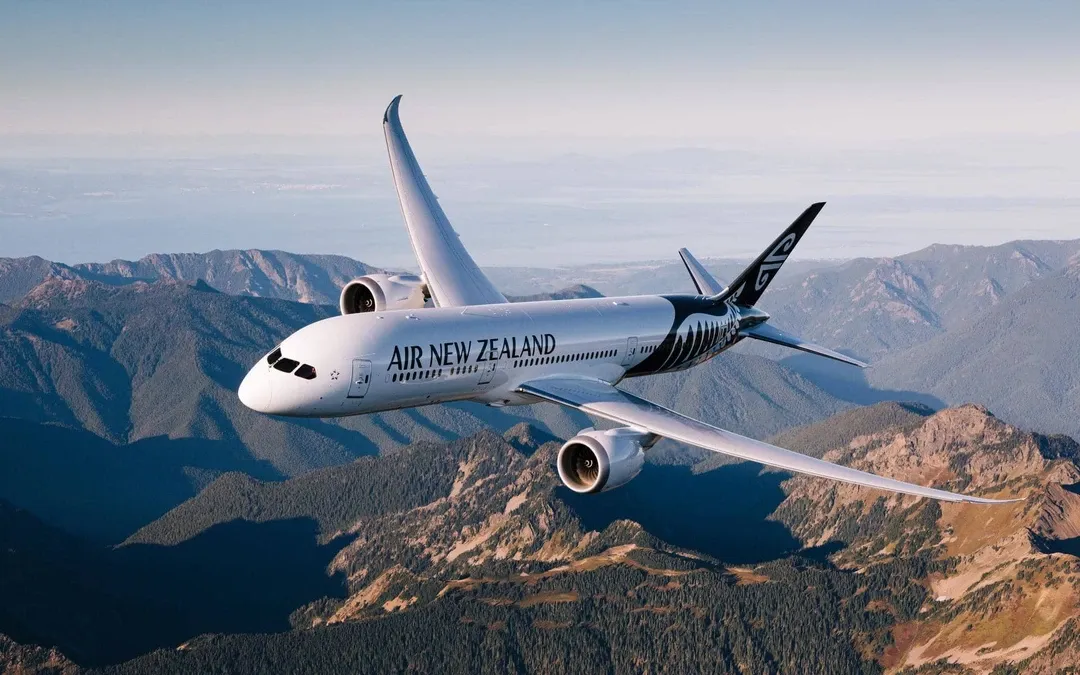
Air New Zealand has posted a $242 million annual loss, its worst result in years, as fuel costs blown out by the Middle East conflict and a punishing run of engine problems overwhelmed solid gains in passenger revenue.
The airline reported a pre-tax loss of $336 million for the year ended June 30, 2026 — a dramatic reversal from the $164 million pre-tax profit it recorded the year before. Net loss came in at $242 million, compared with a $108 million net profit in 2025. No dividend has been declared.
Revenue actually grew. Total revenue reached $7 billion, up 3.9 percent, with passenger revenue climbing 4.8 percent to $6.1 billion on the back of higher capacity, more passengers, and better yields. Cargo revenue slipped 0.6 percent to $484 million. But costs grew far faster than income — operating costs jumped 11.8 percent, and that gap is what defines this result.
Fuel was the headline villain. The Middle East conflict sent jet fuel prices surging, and Air New Zealand estimated that added $328 million to its fuel bill compared with what it had expected heading into the second half of the financial year. Hedging reduced that to $205 million. After fare increases and capacity cuts, the airline still absorbed an estimated $135 million hit to its pre-tax result from higher fuel alone.
"It's been a very challenging year for aviation, and our financial result reflects these challenges," chief executive Nikhil Ravishankar said. "Given the price sensitivity of air travel, airlines globally have not been able to recover the full increase in fuel costs. We took quick and decisive action through fare adjustments and capacity reductions to balance affordability for customers and maximise recovery and will continue to do so."
Engine problems compounded the damage. Ongoing issues with the Rolls-Royce Trent 1000 and Pratt & Whitney PW1100 engines cost the airline an estimated $190 million through lost capacity, additional lease and engine costs, lower fleet utilisation and operating inefficiencies. It was a significant drag — but Ravishankar said the worst of it was now over.
"There are still residual risks and costs to work through, but we enter 2027 in a considerably more reliable fleet position," he said.
Maintenance was the third major weight on the result. The airline described 2026 as a "peak aircraft maintenance year", with costs rising around $139 million excluding foreign exchange, driven by lifecycle maintenance and additional costs on leased engines. Aviation system costs — which include airport charges — reached $720 million, up $83 million on 2025.
Chair Dame Therese Walsh acknowledged the scale of the external pressure. "The board and management have a well-defined plan to rebuild a financially resilient and commercially sustainable national airline," Walsh said.
There were genuine bright spots. On-time performance improved from 77.5 percent in 2025 to 84 percent in the second half of the financial year. The airline delivered $94 million in transformation savings during the year and has identified a further $135 million in annualised savings expected to flow from 2027. Nine of its 14 Boeing 787s have been retrofitted with new interiors, with the full fleet due for completion by November.
"These are very significant improvements and have been the result of a detailed operational and resilience-driven review of our schedule that included a focused programme of initiatives across our team, and the rollout of new digital tooling in support of operational communication and decision-making," Ravishankar said.
Looking ahead, the airline is not prepared to offer earnings guidance for the 2027 financial year. Jet fuel is sitting around US$150 a barrel, the Middle East situation remains unresolved, and engine disruption — while substantially reduced — will still land an estimated $70 million to $90 million hit in 2027 from continuing lease commitments and underutilised aircraft. Maintenance costs are expected to ease by $50 million to $100 million, but airport charges at some ports are forecast to rise more than 10 percent.
Auckland Airport is shaping up as a particular flashpoint. Air New Zealand said its charges there were expected to rise "very substantially" in 2028 as part of the airport's five-yearly price-setting process — a fight the airline is clearly not backing away from.
On the demand side, Ravishankar pointed to forward bookings as a reason for cautious optimism. "We are seeing encouraging inbound demand with forward bookings into New Zealand. This is a positive signal for tourism and for the country more broadly. New Zealand remains a highly desirable destination, and our investment in our onboard product and unique Kiwi hospitality puts Air New Zealand in a strong position to bring more international visitors to our shores."
"We remain focused on executing our strategic priorities, improving financial performance and positioning the airline for long-term sustainable returns," he said.
The board's position on dividends is straightforward: no profit after tax, no dividend. Shareholders will be waiting.
Share this article
The link has been copied!
Your link has expired. Please request a new one.
Your link has expired. Please request a new one.
Your link has expired. Please request a new one.
Great! You've successfully signed up.
Great! You've successfully signed up.
Welcome back! You've successfully signed in.
Success! You now have access to additional content.