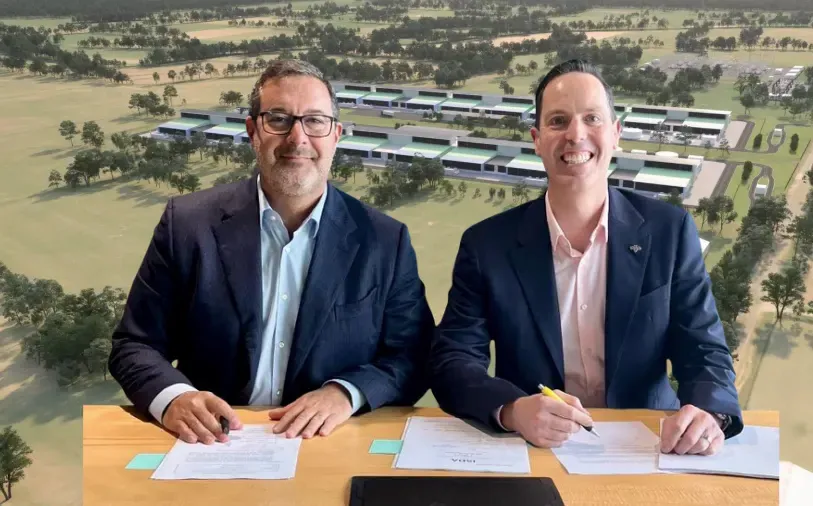
Datagrid New Zealand has signed a major long-term energy agreement with Mercury, securing a 140 megawatt Power Purchase Option Agreement to support its growing artificial intelligence infrastructure. The 15-year deal is among the largest commercial energy arrangements in the country dedicated to high-performance computing and AI operations.
The agreement provides price certainty for Datagrid’s planned hyperscale campus in Southland, which will focus on advanced AI workloads, sovereign cloud services, and high-density computing. The 140MW supply, equivalent to around three percent of national electricity demand, gives the company a stable foundation as it scales its operations.
New Zealand’s strong renewable energy profile plays a central role in the project. With between 85 and 90 percent of electricity already generated from renewable sources, and a target of exceeding 98 percent by 2030, the country offers a low-emissions environment for energy-intensive data infrastructure. The South Island’s fully renewable generation further strengthens Southland’s appeal as a destination for global technology investment.
Rémi Galasso, CEO of Datagrid, said: “This 140MW agreement with Mercury is a cornerstone for Datagrid New Zealand. It enables us to offer international AI players a competitive platform powered by renewable energy, natural cooling advantages, and long-term stability in Southland.
In a world of increasing global uncertainty, we see New Zealand evolving into a secure and trusted hub for AI infrastructure, combining sustainable energy, security, and strategic advantages for AI workloads. Datagrid intends to contribute to this vision through the development of New Zealand’s first AI Factory.”
Mercury CEO Stew Hamilton highlighted the broader economic impact of the partnership. He said: “It’s exciting to support New Zealand’s first AI Factory. Data centres represent a $70 billion economic growth opportunity for New Zealand, according to BCG’s recent Energy to Grow report, with benefits including jobs for locals during construction. This also positively positions Southland and, by extension, New Zealand in this fast-growing sector.
“Having guaranteed customers buying a significant amount of generation means we can continue to invest significantly in new renewable generation for New Zealand, helping meet future demand growth and build resilience.”
Mercury is currently expanding renewable generation, including geothermal and wind projects, alongside significant planned investment in hydro upgrades. Meanwhile, Datagrid’s 280MW AI facility has received resource consent, with construction expected to begin in June and completion targeted for 2028. The build is projected to create more than 1,200 skilled jobs.
The development also includes a new subsea cable linking the South Island directly to international networks, improving connectivity and reinforcing New Zealand’s role in the global digital economy.
Share this article
The link has been copied!
Your link has expired. Please request a new one.
Your link has expired. Please request a new one.
Your link has expired. Please request a new one.
Great! You've successfully signed up.
Great! You've successfully signed up.
Welcome back! You've successfully signed in.
Success! You now have access to additional content.